
Starring: John Cassisi, Jodie Foster and Scott Baio
Written and directed by: Alan Parker
Rated: G
Running Time: 1hr 33mins
WINNER – BAFTA Awards – Best Production Design/Art Direction – Geoffrey Kirkland
WINNER – BAFTA Awards – Most Promising Newcomer to Leading Film Roles (Jodie Foster)
NOMINEE – BAFTA Awards – Best Film
NOMINEE – BAFTA Awards – Best Direction (Alan Parker)
NOMINEE – BAFTA Awards – Best Costume Design – (Monica Howe)
NOMINEE – Academy Awards – Original Song Score and Its Adaptation or Adaptation Score (Paul Williams)
NOMINEE – Cannes Film Festival – Palme d’Or (Alan Parker)
“We could have been anything that we wanted to be
Yes, that decision is ours
It’s been decided
We’re weaker divided
Let friendship double up our powers”
You Give a Little Love – Lyrics by Paul Williams
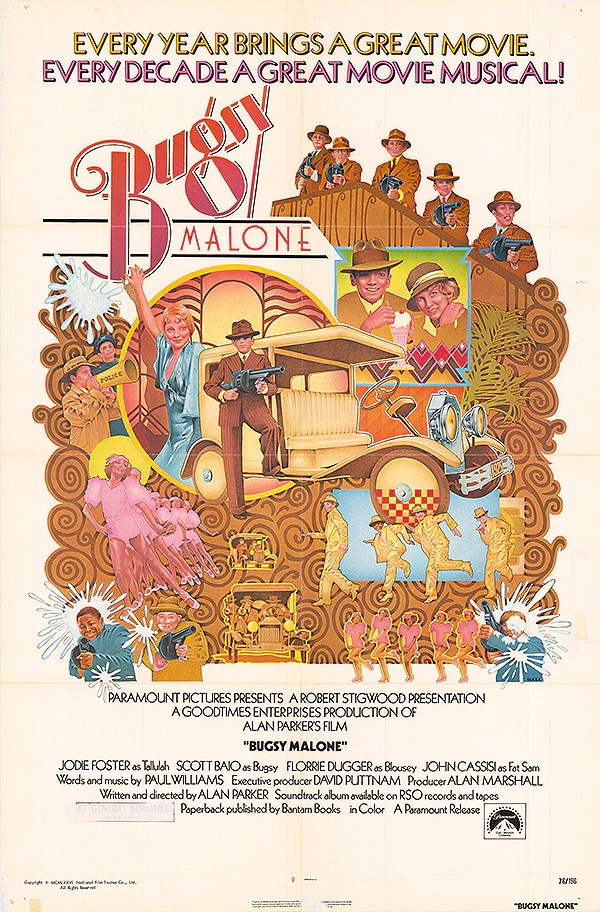
Let’s begin this recommendation with a statement that many may disagree with — “It is my opinion that nobody makes movie musicals better than director Alan Parker.” There I said it. I know some people will argue in favor of a filmmaker like Robert Wise, who created classics such as THE SOUND OF MUSIC and WEST SIDE STORY (yes, there was a better version before Steven Spielberg’s) or maybe the legendary Bob Fosse, who made the great ALL THAT JAZZ and the even greater CABARET. Some may even insist it was Stanley Donen who, along with Gene Kelly, gave us SINGIN IN THE RAIN, a movie that most film lovers call one of the greatest musicals ever made. For me, though, it’s Alan Parker. Throughout his career, he created five musicals, none of which resembles the other in any way. From the music video style of PINK FLOYD: THE WALL (one of my all-time favorite films) to the more traditional, yet realistically toned EVITA… from the musical biopic style of THE COMMITMENTS to the piece of life, almost plotless FAME, Parker repeatedly proved that he really understood how to incorporate musical numbers into the overall tone of the story he was trying to tell. We can also take it one step further and mention that even his straightforward dramas like MISSISSIPPI BURNING and ANGEL HEART showed complete control of music within their brilliant scores by composer Trevor Jones. With all that said, though, these are all movies that most film lovers have either seen or have, at least, heard of. Yet, one of his best was also his feature film debut. It’s a movie that would not be considered an underseen gem in Parker’s homeland, England, where it’s beloved by almost everyone. Here, in the United States, though, most people don’t even know it exists. I am talking about a 1974 family film, BUGSY MALONE.
As both the screenwriter and director, Parker crafted a loving tribute to the American gangster genre that’s a lot of fun in a bizarrely interesting way. Set during the Prohibition era, a time when a person could order an “eight-bamboozle special with double ice cream, 3 beef spitfires, two cream Arizona doughnuts and a salami special,” for only four dollars and eighty cents, the story follows the escalating rivalry between two mob-style gangs. One is led by Fat Sam and the other, his ruthless adversary, Dandy Dan. It’s a story as old as the crime drama itself, as the two men fight for control of the city’s underworld. Then, when Dandy Dan comes into possession of a new kind of weapon, he slowly begins to take out all of Fat Sam’s men. The film’s hero, Bugsy Malone, a young boxing promoter, finds himself caught in the middle of this growing conflict while trying to pursue a relationship with Blousey Brown, a singer who dreams of moving to Hollywood and making it big. There’s everything any fan of the genre could want… gang warfare, deception amongst characters, gunfights, car chases, dancing girls and a little romance, all with continuing nods to everything from Howard Hawks’ original SCARFACE to Francis Ford Coppola’s THE GODFATHER. Some might even suggest that the film was a little ahead of its time, as it foreshadows scenes from future gangster films. For those who love the scene in GOOD FELLAS where Joe Pesci’s Tommy DeVito gives his “So you think I’m funny” speech… well… it was done here first when Sam begins to question his bartender with lines such as, “What’s so funny, Buster? Do you find me amusing?” and “Do you find my suit funny or something?”
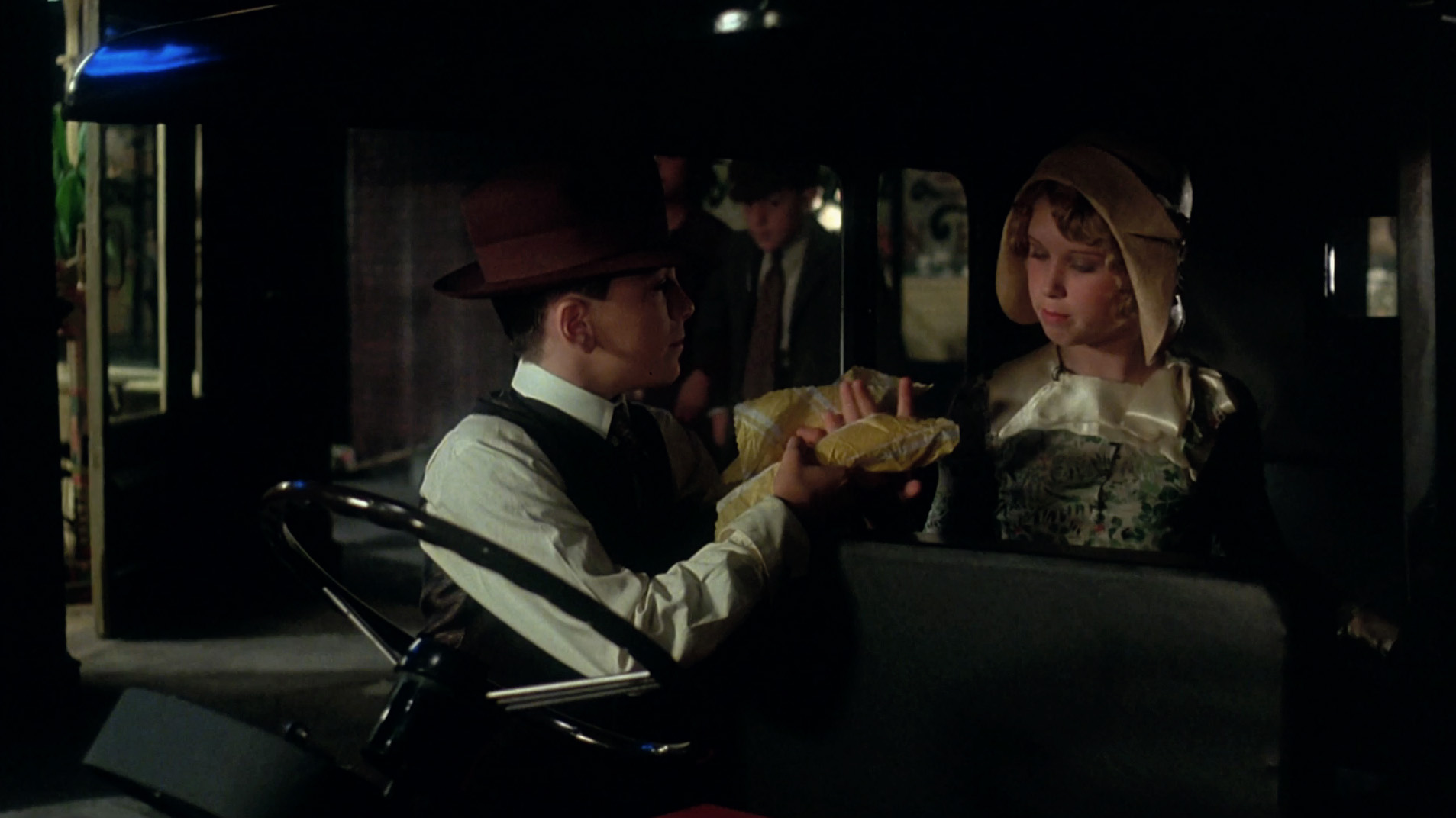
What makes this movie truly unique is the approach Parker took in the casting process. At his own kid Alex’s suggestion, he made the bold move to cast the whole film with kids under the age of 16. Yes, you heard that right… I am recommending a musical gangster film with gunfights and gang warfare that stars only kids under the age of 16. I understand that at first this may seem like a bad idea and even recognize people’s curiosity towards how the movie ever got financed in the first place, but hear me out… the reason it all works is Parker’s incredible commitment to the idea and his ability to lean into everything as a serious filmmaker, making sure that this crazy decision never comes across as a gimmick. What could have become a mediocre live-action family film reminiscent of what Walt Disney Studios was creating in the 60s and 70s… movies like THAT DARN CAT and THE SHAGGY D.A. (Don’t get me wrong, I have a place in my heart for these movies too)… or an obvious gangster parody similar to Amy Heckerling’s JOHNNY DANGEROUSLY, was instead handled as a first-rate musical production. As a director, Parker decided to make something that would stand as comparable to the more serious film projects coming out at the time. Working with cinematographers Peter Biziou and Michael Seresin, they created a gritty tone that really respected the gangster films they were paying tribute to, while production designer Geoffrey Kirkland crafted an authentic-looking set design for the child actors to play in. Though shot mostly on sound stages at the famed “Pinewood Studios,” everything feels real to the environment, almost as if they were shooting on location. The speakeasy and cars are scaled down to match the sizes of the children and the attention to detail is nothing short of amazing. The musical numbers themselves are staged incredibly well, with one of my favorites featuring a wannabe dancer singing a song called “Tomorrow“, only to be joined by a female dancer, who adds an interesting emotional element to the number as a whole.
Parker’s use of only kids is a fun decision because of how it transports the audience back to a time when we, as kids, would dress up in our backyards to play cops and robbers with our friends. It was just us, at a younger age, running around with our water guns and having a mindless good time. Sure, the idea of placing kids in these adult situations that revolve around a violent world could have gone completely wrong, yet it doesn’t, because the staging of the individual scenes is presented in such innocent ways. The kids drive cars that might look super realistic, but are actually operated by pedals, similar to the Big Wheels and bicycles of our childhood and the romantic scenes never go past childlike innocence, as the two times Bugsy Malone kisses his love interest, Blousy Brown, he does so by first kissing his fingers and then touching her nose. As for the violence, the guns that the kids shoot don’t use bullets at all, but instead fire pies at their victims and the big showdown that makes up the climactic moment steers away from anything that someone like Brian DePalma might give us by actually staging a huge pie fight. When it comes right down to it, the movie is just a whole lot of crazy fun suitable for adults and kids alike. I will give the naysayers this, though – and, yes, I have heard many podcasters bring it up, which is why I feel it must be addressed – the one moment that probably doesn’t age well is when the showgirl Telula, played by Jodie Foster (Yeah, you heard that right), appears on stage at Fat Sam’s Speakeasy and sings a song while flirting with the male customers. I can see this causing some unease, but, honestly, for me, the staging of it seems to have no real intent other than to see a bunch of awkward kids trying to act like adults and nothing more.
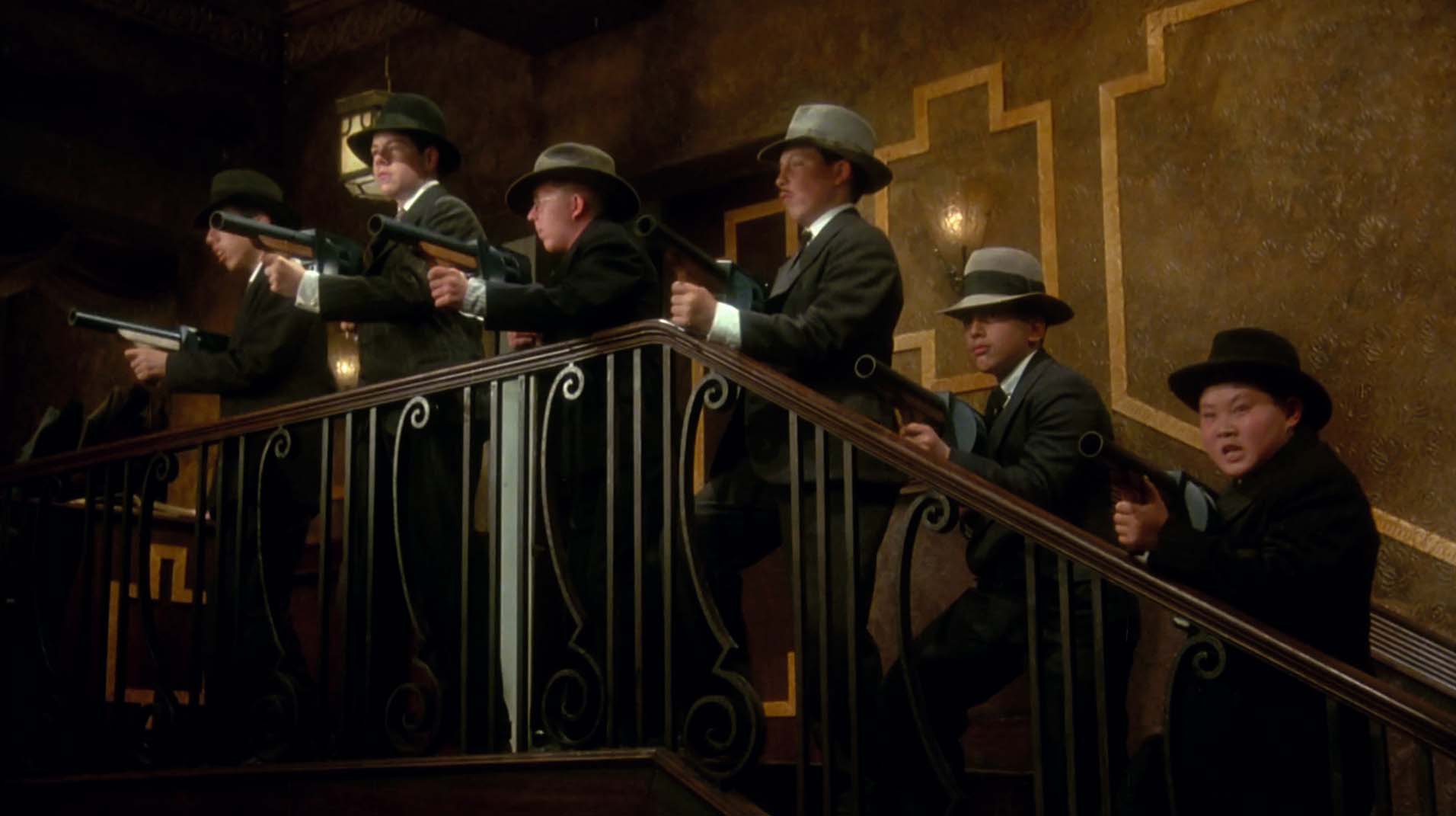
Discussing BUGSY MALONE naturally leads to highlighting its incredible songs, which lift the movie as a musical well above expectations. There isn’t a bad song among them and the climactic number uses an earworm mentality that will keep the final song buzzing around inside the viewer’s head long after the film is over. All of this is because Parker brought in one of the all-time great songwriters, Paul Williams, to work on the project. Most will remember him for writing the Oscar-nominated “The Rainbow Connection” for THE MUPPET MOVIE, the Oscar-winning “Evergreen,” which he co-wrote with the legendary Barbara Streisand for the film A STAR IS BORN and the Grammy Award-nominated “We’ve Only Just Begun,” written for the Carpenters. For BUGSY MALONE, Williams effectively delivers songs that reach every emotion needed to tell this particular story… from the heartfelt “Tomorrow” to the fun “Bad Guys.” There is one complaint I’ve heard regarding the music, which revolves around the fact that the kids are not actually singing the songs but are, instead, made to lip-sync to the voices of adult singers. Even Parker himself had been known to say it was a decision that he regretted. I mention it here because I strongly disagree with this assessment and I feel that the bizarre nature of having kids riding around in pedal cars while shooting guns loaded with pies is only enhanced by these inappropriate adult voices coming from the child actors during the musical numbers. Ultimately, the crazier the film gets, the more fun the movie-watching experience is.
Ultimately, filmmaker Alan Parker was best known for the very serious tone that he brought to films such as MIDNIGHT EXPRESS, MISSISSIPPI BURNING, BIRDY, SHOOT THE MOON and COME SEE THE PARADISE and it does seem odd that he would get his start with a film as playfully weird as BUGSY MALONE. That being said, his talent as a filmmaker and his expertise with musicals like EVITA, FAME, PINK FLOYD THE WALL and THE COMMITMENTS made him strangely the perfect director for this Underseen Cinematic Treasure, which I can only hope more people check out.
Watch BUGSY MALONE
You May Also Like